

I recently wrote a post about the intense anxiety of living with a newly healed pressure wound. Shortly after publishing it, a wonderful reader reached out with some incredible advice that completely reframed how I view my current mental state. They reminded me of a fascinating piece of evolutionary biology that changed my entire perspective this week—and I knew I had to share it with the rest of you.
Before we dive into that advice, let’s look at where I am right now:
I recently crossed a major health milestone. My pressure wound is finally healed.
Logically, I should be celebrating. I should feel relieved, relaxed, and ready to move on. Instead, I find myself checking it constantly, stressing over every minor sensation, and waiting for the other shoe to drop. My nervous system has felt completely fried and super overwhelmed by this constant state of high alert.
Even worse, this constant state of panic is sending my pain levels right through the roof. Because my nervous system is completely overrun, it amplifies every single tingle and phantom itch into a major emergency.
If you are living with a newly healed injury or chronic condition, you know this exact feeling. It turns out, our brains are actually wired to keep us stuck in this state of worry and pain.
The Ancient Security Guard in Your Brain
Deep inside our brains sits the amygdala. It is our emotional processing center, specifically designed to keep us alive.
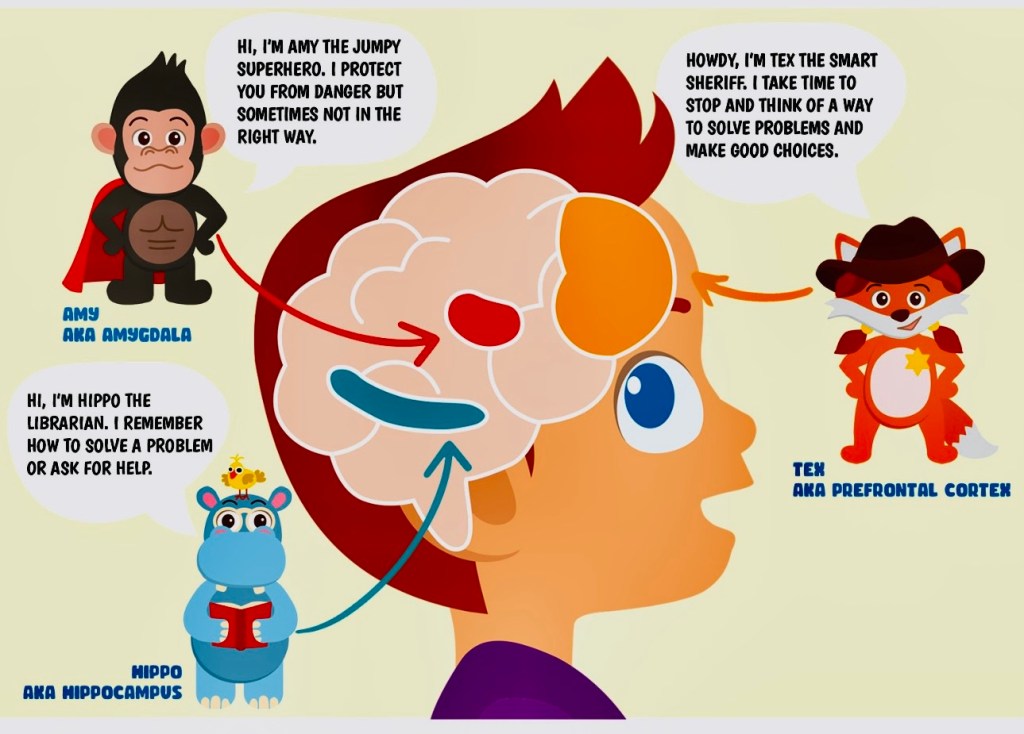
The catch? Our amygdalas haven’t had a software update since caveman times.
Back then, the humans who survived weren’t the ones looking at beautiful sunsets. The survivors were the hyper-vigilant, slightly paranoid ones who assumed every rustle in the bushes was a saber-toothed tiger.
Because of this, our brains evolved with a negativity bias. The amygdala dedicates roughly 70% of its power to scanning for threats. It is designed to think: Better safe than sorry.
Enter the “Monkey Mind” and the “What-Ifs”
This ancient bias unleashes what psychologists call the monkey mind—that restless, loud part of the brain that leaps from one branch of worry to the next. The monkey mind hates uncertainty. To “protect” you, it starts constantly overthinking and obsessing over worst-case scenarios.
It floods your consciousness with an endless loop of terrifying “what-ifs”:
- What if the skin breaks open again tomorrow?
- What if I sat down for five minutes too long?
- What if that tiny tingle means the damage is coming back?
The monkey mind swings wildly from one anxious thought to another, keeping your thoughts racing, skyrocketing your physical pain, and making it impossible to find any peace.
The Trauma of a Pressure Wound
When you are dealing with a pressure wound, the threat is real. It requires constant vigilance, offloading, checking, and medical care. Your amygdala correctly identified this wound as a major hazard to your survival, and your monkey mind went to work mapping out every possible danger.
They did their jobs. They went into overdrive, flooding your system with stress hormones to make sure you paid attention and took care of it.
But now, the skin is intact. The medical danger has passed.
The problem is, no one told your amygdala or your monkey mind.
The Modern Disconnect & The Pain Loop
Because the amygdala operates on ancient survival rules, it cannot distinguish between an active, dangerous wound and the memory of one.
- The Reality: The skin is closed and rebuilding its strength.
- The Amygdala’s Logic: “We were hurt here before. It was terrible. We must hyper-focus on this exact spot forever so it never happens again.”
Every minor shift in your seat triggers that ancient fight-or-flight response. When your nervous system stays overrun like this, it acts like a microphone for pain—cranking the volume up on sensations that should just be a quiet tingle. Your brain isn’t broken, and you aren’t being irrational. You are just trapped in a physical pain loop caused by an ancient survival program that doesn’t know how to turn itself off.
Tools I’m Using to Calm the Storm.
Knowing why my brain is doing this helps, but it doesn’t automatically quiet a loud monkey mind or stop the physical pain. To help my caveman brain realize we are safe and bring my overrun nervous system back down to baseline, I am actively using these tools:
- Interrupting “Negative Nelly” and the Monkey Mind: Whenever those spiral thoughts creep in—what I like to call my “Negative Nelly” thoughts—and the monkey mind starts screaming what-if, I step in with a specific mantra. I tell myself: “I am safe. I am safe. I am safe.” Repeating this acts like a circuit breaker for my mind. It sends a direct signal to my body to relax the nervous system, lower the alarm, and quiet the inner chatter.
- Qigong (Qi Gong): Slowing down my physical body is essential when my mind is racing. I practice Qigong to connect my breath with slow, fluid movements. Moving my energy this way breaks up the stagnant stress, gently shifts my body out of fight-or-flight mode, and forces my nervous system to relax.
- Daily Meditation: Sitting with an overrun nervous system isn’t easy, but dedicated meditation gives me a safe space to watch my thoughts without reacting to them. It teaches my brain to be the observer of the pain and anxiety, rather than getting swept away by it.
- Somatic Tapping (EFT): When the pain starts climbing, I use light finger tapping on my collarbone or brow while breathing deeply. This physical tool helps ground my body in the present moment, telling my overrun nervous system that there is no tiger in the room.
- Acknowledging the Alarm: When I start to panic over a physical sensation, I literally tell myself, “Thank you, brain, for trying to protect me. But we are safe right now.”
- Fact-Checking the Fear: Instead of letting my mind spiral into “what-ifs,” I rely on objective checks. Is the skin intact? Am I following my offloading routine? If yes, the data says I am okay.
- Rewriting the Bias: When I do a skin check and everything looks good, I force myself to sit with that positive realization for 20 seconds. This helps build new, safer pathways in my mind.

Healing is a physical process, but recovering from the stress of being wounded is a nervous system reset. If your brain is still acting like you’re in the middle of a health crisis and making your body ache, give yourself some grace. Your inner caveman and your monkey mind are just trying to keep you safe—we just have to gently use our tools to show them the danger has passed.

