
Feeling the wobble? It is a sensation most of us know all too well, yet we rarely talk about it with raw honesty.
Life has a habit of throwing our bodies out of alignment. Whether it is a shift in our hormones, the chaotic rush of the holiday season, or an unexpected bout of illness, these moments can leave us feeling a bit frayed, disconnected, and thoroughly “wobbly” around the edges. When you look in the mirror, the person looking back might not match how you feel inside, creating a quiet disconnect that is difficult to articulate to the outside world.
But when you layer those universal human experiences on top of a Spinal Cord Injury (SCI), the wobble stops being a temporary phase. It becomes a daily, deeply complex reality.
For the past year, my life has been defined by a massive physical hurdle: spending 6.5 months on strict bedrest. When you spend half a year lying flat, your relationship with your body fundamentally changes. Emerging from that chapter has forced me to confront a reality that is equal parts frustrating, humbling, and profound. If you have ever felt like your body is an unpredictable stranger, or if you are fighting your own uphill battle to reclaim your health, I want to share what this journey looks like from the inside out.
The Daily Body Metamorphosis: Hormones & The ‘Para Belly’
One of the most exhausting aspects of chronic illness and physical recovery is the sheer lack of predictability. Because of constant hormonal changes, my body can look and feel totally different each and every day. I can wake up one morning feeling relatively aligned, only to find that by the afternoon, fluid retention, bloating, or systemic fatigue has completely altered my physical outline and energy levels. It is an exercise in vulnerability to never quite know how your clothes will fit from one sunrise to the next.
For an able-bodied person, hormonal fluctuations are annoying. For someone living with an SCI, they intersect with specific secondary complications that amplify the frustration.
Enter the “para belly.”
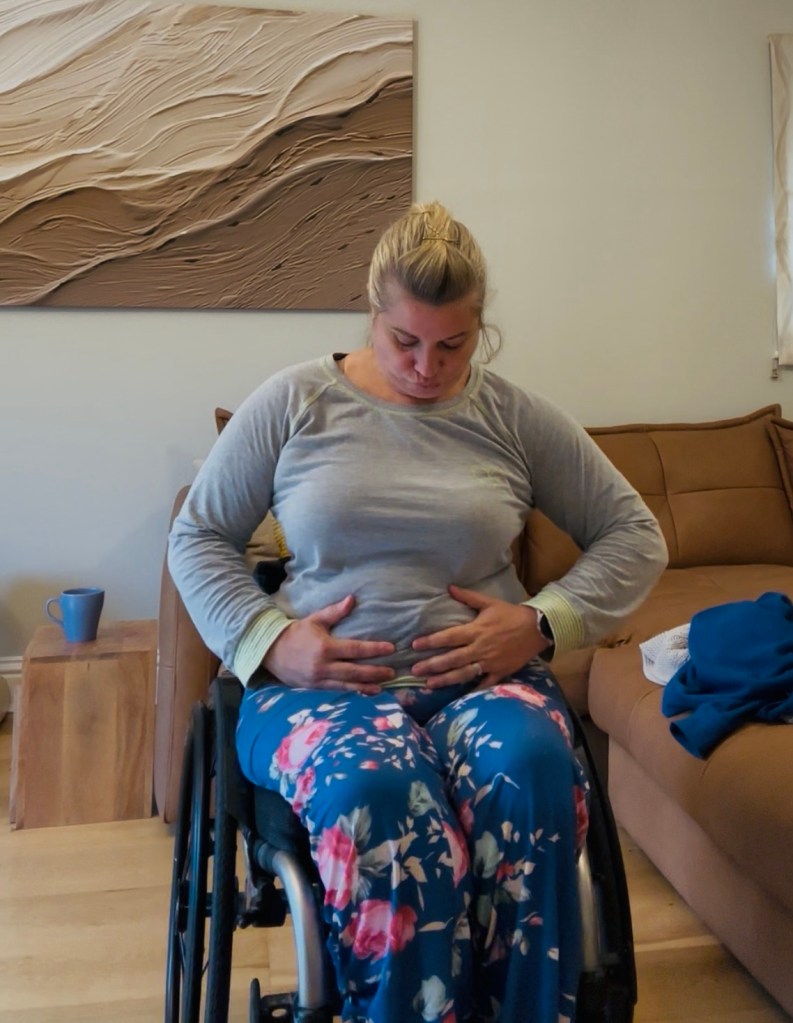
For those unfamiliar with spinal cord injuries, a para belly occurs because of the paralysis or weakness of the abdominal muscles. Without the underlying nerve signals and muscle tone to hold the internal organs firmly in place, the abdomen naturally protrudes more than it used to. It has nothing to do with body fat percentages or a lack of effort; it is a structural, neurological change.
When you mix constant hormonal shifts with an SCI and a para belly, it feels like an unrelenting, uphill battle. You look in the mirror and struggle to recognise the silhouette looking back at you. It becomes incredibly easy to look at yourself through a lens of harsh judgment, comparing your current shape to a past version of yourself, or worse, to an idealised standard that does not account for your medical reality.
Confronting the Loudest Room: The Inner Critic
When your body feels chaotic, your mind often tries to compensate by becoming a strict, unforgiving taskmaster. This is where the inner critic steps in, pulling you down into a spiral of negative self-talk.
Lately, my inner critic has been incredibly loud. It sits on my shoulder and whispers an endless list of demands:
- “You aren’t doing enough.”
- “You need to push harder.”
- “Why haven’t you lost the weight yet?”
- “You should be healing faster, doing more exercises, and trying harder.”

It demands that I do all the things, all at once. It wants me to radically overhaul my diet, execute a flawless adaptive fitness routine, magically erase the physical toll of the last year, and feel completely vibrant by tomorrow morning.
But this hyper-aggressive approach is a trap. The inner critic thrives on perfectionism, and perfectionism is the enemy of sustainable recovery. When you are healing from months of forced inactivity, trying to “push through the pain” or force an accelerated timeline does not lead to faster results. It leads to burnout, re-injury, and emotional despair.
The Reality of the Reset: Reclaiming Life After 6.5 Months of Bedrest
To truly understand why the inner critic is so wrong, I have to look objectively at what my body has endured. This past year, consistency was entirely out of reach. I spent 6.5 months on bedrest—half a year of lying down, losing muscle mass, watching my cardiovascular endurance decline, and gaining weight simply because my body was entirely immobile while trying to heal.
Bedrest is not a vacation. It is a psychological and physical crucible. Your joints stiffen, your metabolic rate drops, and your independent agency is stripped away. When you finally get the green light to move again, you do not just pick up where you left off. You start from a deficit.
Acknowledging this is not an excuse; it is radical self-honesty. I cannot expect a body that was immobilised for over twenty-six weeks to suddenly sprint a marathon. The weight gained during bedrest was a byproduct of survival and healing. The weakness I feel is a natural physiological response to lack of gravity and movement. When consistency has been stolen from you by medical necessity, you have to redefine what consistency means moving forward.

The Power of the 1% Shift: Turning to Baby Steps
So, how do you combat a loud inner critic and a body that changes by the day? You change the metrics of success.
I know that true transformation relies entirely on baby steps, time, patience, and consistency. Since a massive, overnight overhaul is impossible, I am choosing to focus on a philosophy that feels manageable: getting 1% better today.
Instead of asking myself, “How do I lose all this weight and get perfectly strong this week?” I ask:
- Can I drink one extra glass of water today?
- Can I do five minutes of purposeful stretching or activation exercises from my chair?
- Can I practice five minutes of deep breathing to calm my nervous system?
- Can I speak to myself with just a fraction more kindness when I look in the mirror?
One tiny change might seem insignificant in isolation. If you do it for one day, nothing looks different. But when you put these micro-actions into motion day after day, they compound. One small shift leads to a slightly better habit, which leads to a massive result over time. The 1% rule takes the pressure off. It allows me to build momentum without triggering a physical flare-up or an emotional collapse.
Moving Forward: Piece by Piece
Reclaiming your life after an extended medical trauma is an act of reconstruction. I am choosing to make this process public, not because I have it all figured out, but because I know there are others sitting in the middle of their own silent battles.
As I move forward, my journey is focused on three distinct pillars:
- Releasing the Bedrest Weight: Approaching weight loss not from a place of self-hatred or punishment, but as a gentle shedding of a layer that protected me while I was immobile.
- Strengthening My Body: Re-engaging muscles that forgot how to fire, building back endurance slowly, and honouring the limits of my nervous system.
- Rebuilding My Self-Confidence: Pushing through the self-doubt and putting my outer self back together, piece by piece, like a complex puzzle.
My body might look different every single day, and the uphill climb might feel steep, but I am still climbing.